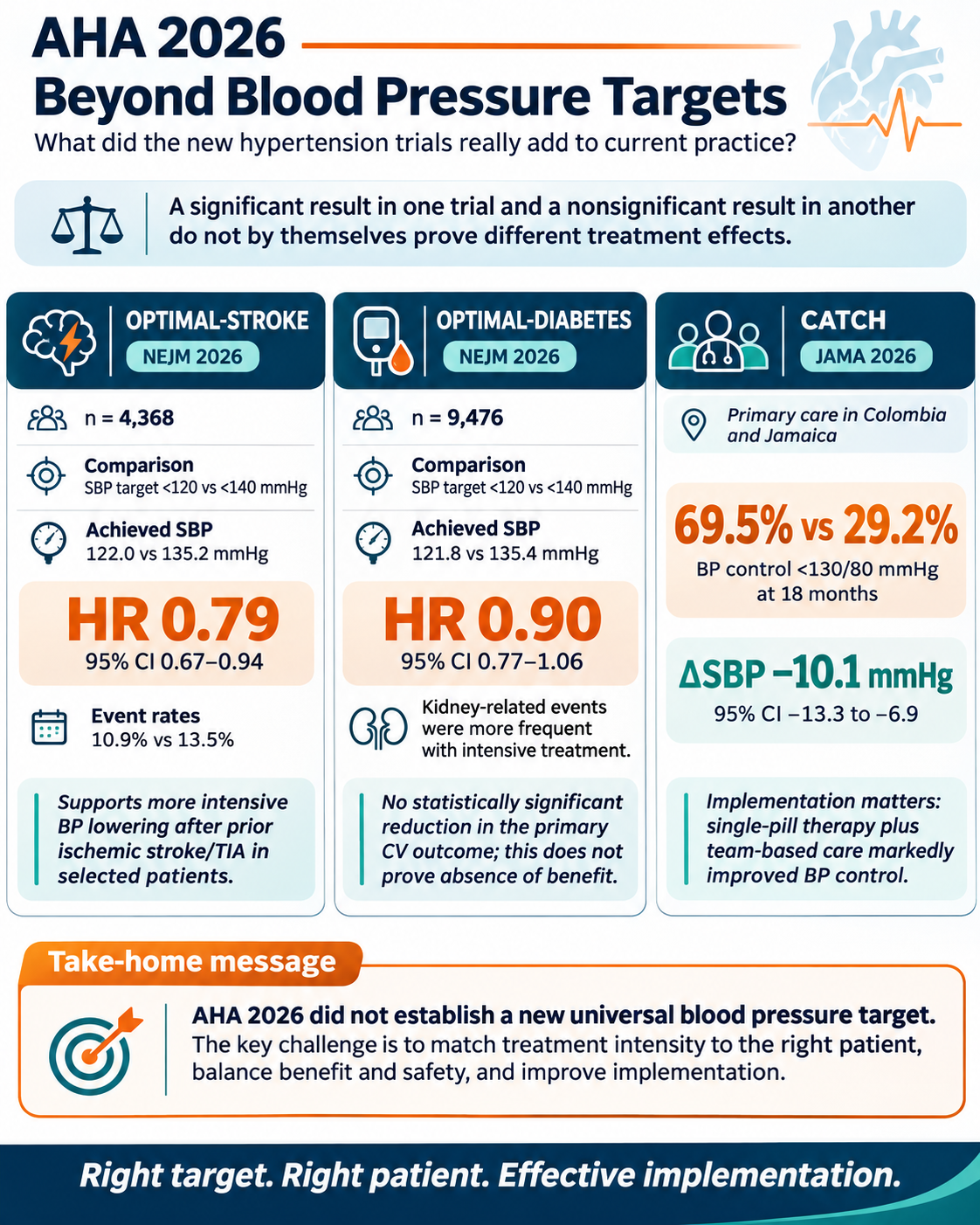
OPTIMAL-STROKE (n=4,368): Intensive treatment reduced major cardiovascular events (HR 0.79; 95% CI 0.67–0.94).
OPTIMAL-DIABETES (n=9,476): The reduction was not statistically significant (HR 0.90; 95% CI 0.77–1.06).
Kidney-related events were more frequent with intensive treatment.
But are these results truly contradictory?
Not necessarily.
A statistically significant result in one trial and a nonsignificant result in another do not establish a difference in treatment effects. Moreover, BPROAD previously demonstrated cardiovascular benefit from intensive BP control in patients with type 2 diabetes.
Another important consideration: the standard-treatment groups achieved approximately 135 mmHg. Neither OPTIMAL trial directly tested whether <120 mmHg is superior to the <130 mmHg target already recommended in contemporary guidelines.
Meanwhile, CATCH addressed a different challenge.
In primary care settings in Colombia and Jamaica, a strategy combining single-pill therapy with team-based care achieved BP control <130/80 mmHg in 69.5% versus 29.2% of patients at 18 months.
My interpretation:
The next challenge in hypertension is not simply to pursue lower numbers.
It is to identify who benefits from greater treatment intensity, balance cardiovascular protection against adverse effects, and ensure that effective strategies can actually be implemented.
Perhaps the most important question after AHA 2026 is not “How low should we go?” but “How can we deliver the greatest clinical benefit safely and consistently?”
- • OPTIMAL-STROKE — NEJM 2026. DOI: 10.1056/NEJMoa2612924 • OPTIMAL-DIABETES — NEJM 2026. DOI: 10.1056/NEJMoa2612922 • CATCH — JAMA 2026. DOI: 10.1001/jama.2026.24169