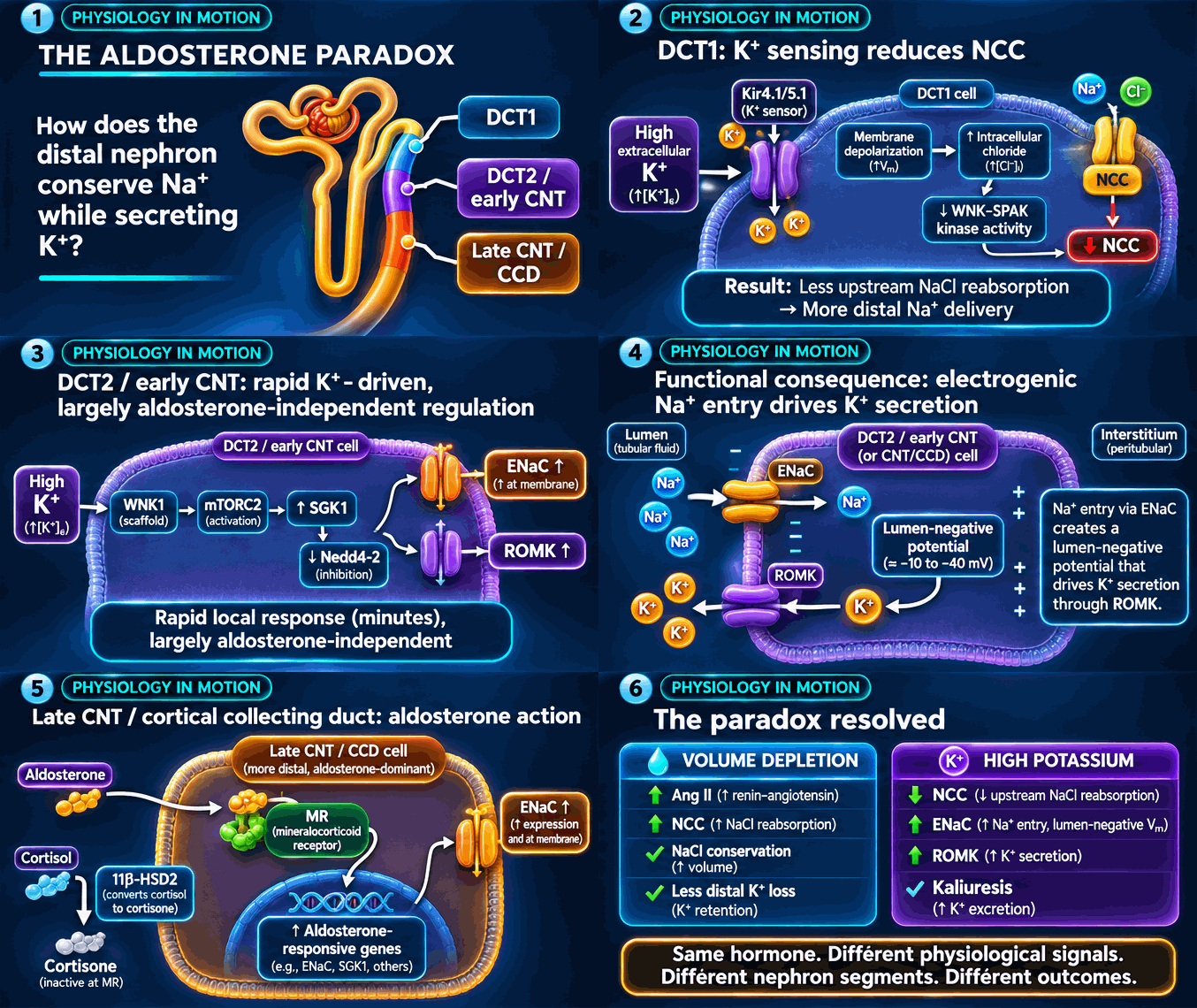
How can aldosterone help preserve sodium during volume depletion—without excessive potassium loss—yet promote potassium excretion after a potassium load?
A fascinating review by Pearce and Korbmacher proposes that the answer lies in WHERE the signal acts along the distal nephron.
1 | POTASSIUM IS A SIGNAL, NOT JUST AN ION TO EXCRETE
When interstitial K⁺ rises, distal tubular cells sense it through changes in membrane voltage and intracellular chloride.
This inhibits WNK–SPAK signaling and reduces NCC activity: less NaCl reabsorption upstream, more sodium available downstream.
2 | THE SAME SENSOR ACTIVATES A SECOND PATHWAY
WNK proteins can also act as scaffolds, bringing mTORC2 and SGK1 together.
Activated SGK1 inhibits Nedd4-2 → more ENaC at the apical membrane → greater electrogenic Na⁺ entry.
The resulting lumen-negative voltage favors K⁺ secretion through ROMK.
3 | LOCATION CHANGES THE RESPONSE
In late DCT/early CNT, the authors propose that mineralocorticoid receptors are largely occupied by glucocorticoids, while K⁺ locally regulates ENaC and ROMK.
Further downstream, in late CNT/cortical collecting duct, aldosterone-dependent regulation becomes more prominent.
Now compare two physiological situations:
VOLUME DEPLETION → ↑ angiotensin II → ↑ NCC → NaCl conservation and reduced distal Na⁺ delivery, limiting K⁺ loss.
POTASSIUM LOAD → ↓ NCC + ↑ ENaC-driven K⁺ secretion through ROMK → kaliuresis without an equivalent need for sodium retention.
My interpretation: The aldosterone paradox may be less a paradox of one hormone than a demonstration of segment-specific signaling and exquisite renal adaptation.
Importantly, this is a mechanistic synthesis and proposed model, not a new clinical trial. Some segment-specific details and human implications still require validation.
Understanding these pathways may eventually improve how we approach hypertension, potassium disorders, and mineralocorticoid-related therapies.
- Pearce D, Korbmacher C. Differential Regulatory Activities of Potassium and Aldosterone in the Distal Nephron: A Resolution to the Aldosterone Paradox. Annual Review of Physiology. Published online November 6, 2026. DOI: https://doi.org/10.1146/annurev-physiol-040425-040610